A painting by Newt Thomas, depicting a view of my grandmother’s hometown of Lyons, Colorado, hung in my grandparent’s modest 1920s bungalow home in Longmont for over sixty years. In a his-and-hers arrangement, it flanked one side of a large mirror that once hung in my great-grandfather’s short-lived candy store. On the other end of the long mirror, my grandfather’s World War I dog tags and medals from service in France with a forestry division of the U.S. Army Corps of Engineers were displayed in a red-velvet lined shadow box. I spent countless hours of my childhood gazing at that familiar Front Range landscape from my seat at the table during meals and rounds of gin rummy.
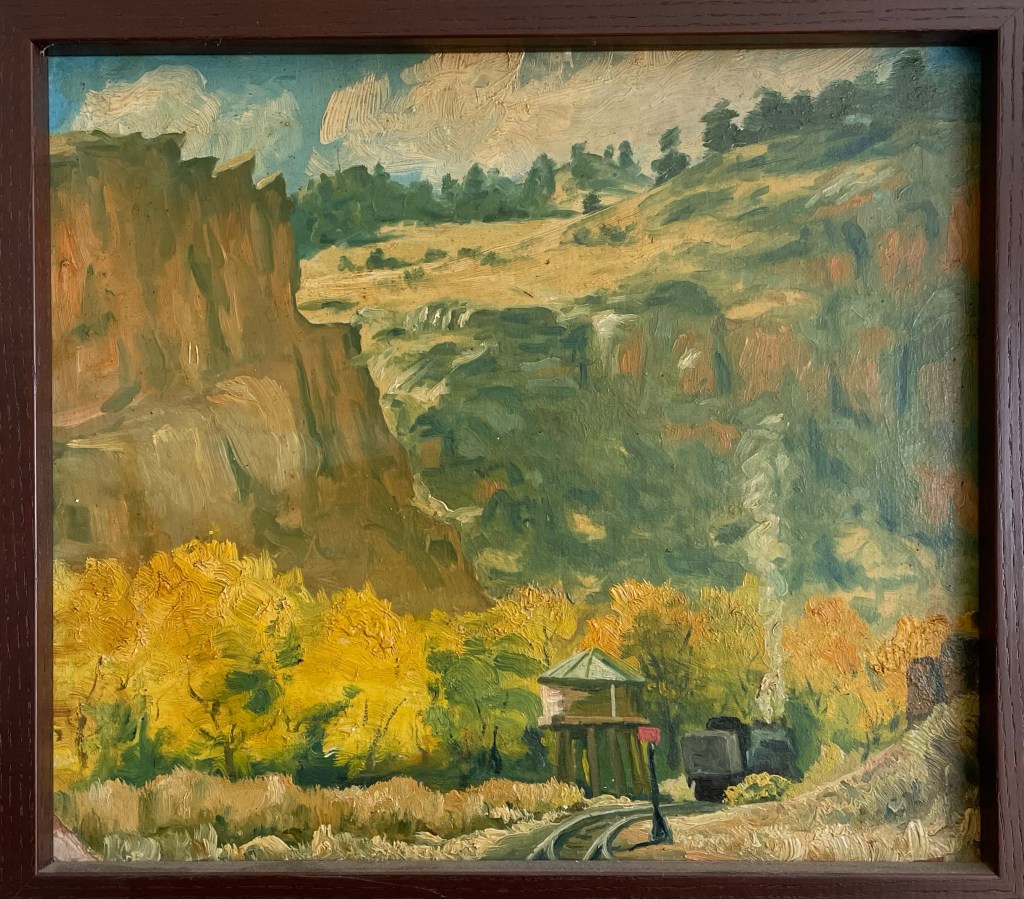
This view is just few blocks from downtown Lyons, “The Double-Gateway to the Rockies,” a small town situated at the base of the foothills and the confluence of the north and south forks of St. Vrain Creek. The autumnal yellow cottonwood trees in the picture line the unseen North St. Vrain Creek rushing through the mountain and meadow landscape with water tower and steaming train engine. Although the tower and train tracks are long gone, the view, having been preserved in 1920 as Meadow Park (now LaVern M. Johnson Park), still exists today.
My grandmother dearly loved this image that evoked memories of her childhood. Her father, E.P. Sweeney, whom she described as a proud, flame-haired Irishman from Scotland, was the Burlington station agent in Lyons for many years, after having worked for a local red sandstone quarry.
Born in 1900 before labor laws were enacted, my grandmother regularly worked in the office as a child where she met many interesting people, including the Stanley brothers, the East Coast steam-engine automobile manufacturers who provided “mountain wagon” service from the depot to the elegant Stanley Hotel in Estes Park adjacent to Rocky Mountain National Park. Trains, creeks, canyons, and the red sandstone cliffs that put Lyons on the map, were meaningful to my grandmother.
When my mother bequeathed the painting to me, I happily accepted the gift. As it has traveled with me east of the Mississippi River for graduate school and then south for employment, I’ve gazed at it over many years with a nostalgic longing perhaps not unlike my grandmother’s.
Since owning the painting I’ve wanted to know more about the artist. Cursory research has revealed little and I’ve kept a Newt Thomas research project in mind but not in practice.
That changed last summer while enjoying a picnic lunch in LaVern M. Johnson Park. While watching people enjoy the park and float the creek, I realized it was time to activate a research project I’d kept on hold for so long. What sparked the decision? Like the merging creeks, a number of thoughts came together.
I had recently learned that the park’s namesake, the founder of the Lyons Historical Society and passionate local historical preservationist, had recently died at the age of 95. While the population of Lyons is less than three thousand people, it is nestled in the Front Range, a region that has experienced explosive population growth in recent decades. The pressures of development often occlude or erase local histories, especially as the generations of individuals with direct ties to the histories of their communities diminish and disappear.
Threatening culture as much as nature, increasingly frequent catastrophic environmental events related to climate change, like floods and wildfires (both have directly impacted Lyons or occurred nearby), are worrisome to an art historian such as myself. I’m sensitive to how common it is for artworks and knowledge associated with them to become disassociated and lost.
For an artist like Newt Thomas who has not been well-studied or documented, it wouldn’t take much for the remaining traces of his life’s work to disappear. A lifelong painter, what we know about him is fragmentary and enigmatic: a few biographical details, brief and often humorous mentions in local newspapers, and less than thirty attributed paintings, mostly in the collection of the Lyons Redstone Museum.
Academic research tends to follow a specific pattern of research, writing, and presentation. The first two parts—research and writing—are usually solitary endeavors not privy to the public. The third component—presentation—is often confined to academic papers presented at conferences or publications in peer-reviewed journals not accessible to a lay audience.
This project will be different. Through this blog site and companion Instagram account, @newt_thomas_is_an_enigma, I invite you to share the research experience with me.
While I don’t know exactly where it will lead–research sometimes leads into rabbit holes and dead ends–my objectives are to locate and examine as many paintings by Newt Thomas as I can find, to track his travels and painting excursions, to dig into archives, to write a more detailed and nuanced biography, and to curate a public exhibition in Lyons.
It will be an interesting journey—please join me!


One response to “What is this project?”
[…] explained in the first post, a stop for a picnic lunch in Lyons on my summer vacation in 2022, inspired this project. After the […]
LikeLike